MAKING AN IMPACT
Researchers at ETH Zurich have developed a new robotic additive manufacturing method for low-carbon material that’s poised to make the construction industry more sustainable
Researchers from ETH Zurich, a public research university in Zürich, Switzerland have developed a new, fast robotic printing process for materials that doesn’t require cement. Known as ‘impact printing’, construction robots working on-site shoot material from above, gradually building a wall. On impact, the parts bond together and very minimal additives are required. Unlike concrete 3D printing, the process does not require any pauses during which the material can solidify. Materials such as excavated materials, silt and clay are used in the process – entire houses can be built from clay or excavated earth. As it doesn’t require cement, material is cheap, abundant and sustainable.
New additive manufacturing method
Impact printing is a novel robotic additive manufacturing method for constructing full-scale, freeform wall structures with circular and low-carbon materials. The process was developed at ETH Zurich through an interdisciplinary collaboration. The aim was to increase the cost competitiveness of sustainable building materials through efficient and automated production. In contrast to layer-based 3D printing, this robotic construction method is based on controlled, high-velocity deposition of dense material parts. By depositing material at velocities up to 10m per second, the process can achieve bonding and dry joints are not an issue. Compared to typical extrusion-based 3D printing, the process deposits material in a more stable condition and thus, it is less dependent on additives for accelerating the mechanical strength from a liquid to a solid state.

Robotic off-site construction
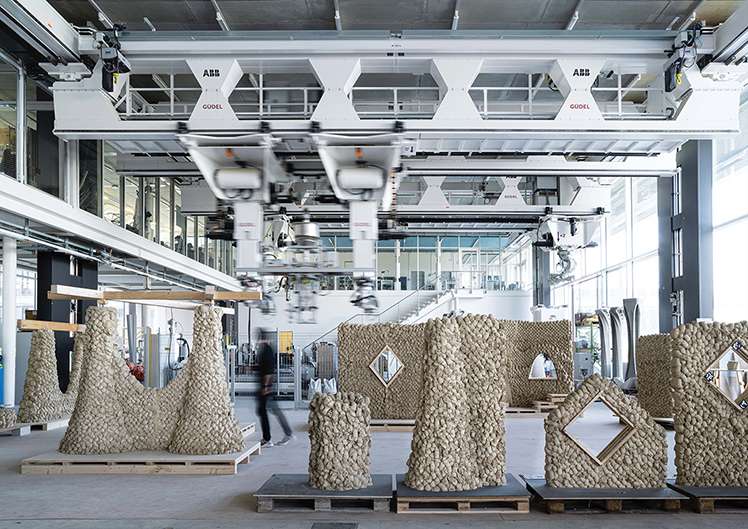
A completely custom printing tool was developed that can be integrated on multiple high-payload robotic platforms. This enables the construction process to be realised in offsite production scenarios, as well as onsite construction scenarios directly on the building site. The tool has been integrated with a high-payload gantry system in the state-of-the-art Robotic Fabrication Laboratory at ETH Zurich.
The hardware can also be mounted on an autonomous legged excavator, developed by the Robotic Systems Lab and it has been used to successfully build structures as tall as 3m. The HEAP platform is a state-of- the-art legged excavator that’s been modified for autonomous operation. In the future, this could enable the construction process to be deployed directly in unstructured sites with variable terrain to realise wall structures and infrastructure such as acoustic barriers.The robotic additive manufacturing process enables the production of customisable wall and column structures.
Novel software and computational design methods were developed to design these structures and control the robotic construction process. Methods for robotic surface finishing using ecological plasters can be used to achieve a high-quality surface finish.

Low environmental impact
The additive manufacturing process was specially developed for circular materials with low embodied CO2, such as earth-based and excavated materials. A low environmental impact earth-based mixture has been developed by the Chair of Sustainable Construction at ETH Zurich. This mixture includes several components – primarily locally sourced secondary material with a minimal amount of mineral admixture. Most of the material is sourced locally from by-products from an industry partner, Eberhard Unternehmungen, a leader in circular methods for the building sector. The robotic additive manufacturing method could be extended to other materials in the future for other load cases and application scenarios.
This new robotic additive manufacturing method for circular, low-carbon material is poised to make the construction industry more sustainable.The process won the Architecture award at the 3D Pioneers Challenge in 2023, an international competition for “Additive Manufacturing processes and Advanced Technologies”, considered one of the most prestigious awards of its kind. The college is planning to establish an ETH spin-off to commercialise the robotic printing technology.
_____________________________________________________
Michael McDonnell Managing Editor of Irish Construction Industry Magazine & Plan Magazine
Email: michael@irishconstruction.com WWW.MCDMEDIA.IE