SMET DELIVERS WITH EPDS AVAILABLE FOR A DIVERSE RANGE OF BUILDING MATERIALS
With a focus on sustainable construction – SMET delivers with EPDs available for a diverse range of building materials.
Sustainable construction trends have driven the demand for environmental product declarations (EPDs) for building products. In many building certification systems, the criteria for evaluating sustainability include a standardised, systematic life-cycle assessment (LCA), which – as the name suggests – covers a building’s entire lifespan.
The data used in these assessments are based on EPDs prepared in accordance with international standards ISO 14025 and EN 15804. EPDs contain statements on the energy and resource use as well as the extent to which a product contributes to the greenhouse effect, acidification, eutrophication, destruction of the ozone layer and smog formation. They also include details of the technical properties needed to assess the performance of a particular product in the building, e.g., in terms of service life or impact on indoor air quality.
The ability to Assess Life Cycle Impacts
Environmental Product Declarations (EPD) are a standardised way of providing data about the environmental impacts of a product through the product life cycle.
In Europe, they must conform to the European Standard, EN 15804, which ensures that EPD for construction products use a common methodology, report a common set of environmental indicators, and have a common reporting format. This means that EPD can be integrated into building level assessment and used to compare construction products in a building context.

EPD including all life cycle stages is known as “cradle to grave” EPD. EPD can also show the potential benefits of any reuse, recovery, or recycling after end of life in Module D. These modules and stages are standardised across products and building-level environmental assessment (using EN 15978, another of the CEN/TC 350 suite of standards for sustainable construction) so that EPD data can be easily used at building level to assess the life cycle impacts.
Sources of impacts
Remember a product with an EPD is not automatically a product with low environmental impact – the EPD only provides the environmental information about the product which allows you to discover this by comparing it to other products at the building level. However, in obtaining an EPD, the manufacturer will receive an EPD Project Report which explains the sources of impacts through the life cycle, which will allow them to consider how they might best reduce them.
Most importantly for designers and specifiers, EPDs have a major role to play in enabling better product choices in delivering lower carbon buildings.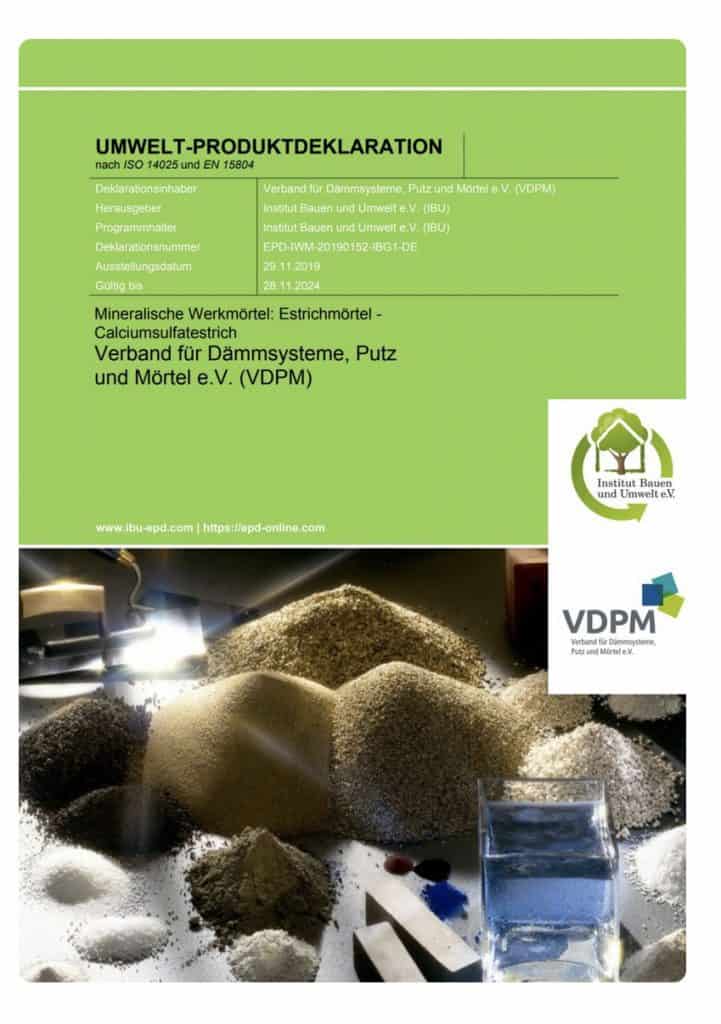 SMET has made it easier to access EPDs for your projects and is delighted to offer a comprehensive listing of over 40 for a range of its superior German-made materials including screeds, tiling, renders, plasters, primers and sealers.
These EPDs are available now, and free for download on the ‘EPD Ireland’ programme – Ireland’s go-to Environmental Product Declaration platform.
To access these third-party verified EPDs, open the platform: www.igbc.ie/epd and search for ‘SMET’.
Why host with EPD Ireland?
The IGBC (Irish Green Building Council) developed the EPD Ireland programme. This allows Irish producers to create an Environmental Product Declaration for their product, using Product Category Rules (PCR) for Ireland and have it verified and published on the platform. EPD Ireland also allow manufacturers to upload EPD from other programme operators on its website as is the case above.
EPD Ireland is a member of Eco Platform, the organisation of European EPD programme operators which ensure the quality of the programme and maximise harmonisation of EPD programmes across Europe.
All the declarations published under EPD Ireland programme are available in digital format (XML and CSV) on the EPD Ireland’s website and on ECO Platform’s ECO Portal. This ensures that the Environmental Product Declarations are made visible to specifiers across Europe and data is ready to use on Building level LCA software.
In 2018, the IGBC also launched the EPD Campaign. This campaign asks specifiers of construction products to demand Environmental Product Declarations and prefer products with EPD where possible within procurement restrictions. The commitment is for all those in the value chain who can influence the specification of products in buildings: investors, developers, home builders, local authorities, engineers, architects, contractors, and consultants.
Likewise, the IGBC has recently developed Carbon Designer Ireland, a free early-stage whole life cycle carbon assessment tool for Ireland and they offer training courses for professionals to learn how to quantify carbon emissions associated with their building designs.
EPDs and the Alliance for Sustainable Building Products
SMET is a member of the Alliance for Sustainable Building Products (ASBP), a non-profit sustainability organisation that seeks to increase interest and uptake in EPD within the industry, particularly via knowledge sharing webinars and briefing papers.
“We are seeing real growth in interest in EPD within our cross-sector membership and wider network. We aim to announce new partnerships with two major EPD providers in early 2022 which we hope will make the EPD process more manageable for SME members and increase the amount of EPD available for construction products.” – Richard Broad, Projects & Communications Manager, ASBP
SMET is also a member of The AECB and can be found listed in the Passive House Plus members directory, Marketplace Plus. Contact ISO 14001 accredited SMET for further information on EPDs when choosing EPDs and making comparisons for your low carbon project.
______________________________________________________
Denise Maguire Editor of Irish Construction Industry Magazine & Plan Magazine
Email: denise@mcdmedia.ie WWW.MCDMEDIA.IE WWW.IRISHCONSTRUCTION.COM